
- Population
- 1,718
- County
- Indiana County
- State
- Pennsylvania (PA)
- Region
- Northeast
- Median income
- $30,192
Black Lick winters aren’t gentle on floors, especially in basements and garages where road salt, slush, and mud track in for months at a time. Polished concrete is one of the few finishes that actually improves under that kind of pressure instead of falling apart.
It’s not just the cold that’s the problem, either. The freeze and thaw that happens over and over through a Pennsylvania winter puts real stress on any floor covering that isn’t built to move with the concrete underneath it. Polished concrete, since it’s part of the slab itself rather than a separate layer, doesn’t have that same failure point.
Why Polished Concrete Holds Up So Well in Indiana County
Between freeze-thaw cycles and everything winter brings inside on your boots, a lot of flooring options just don’t last around here. Polished concrete doesn’t have that problem. Once it’s ground, densified, and polished, it resists staining from salt and moisture far better than sealed concrete or most other floor coverings.
That durability matters even more in spaces like basements and garages, where a floor that’s constantly damp or gritty can otherwise turn into a maintenance headache pretty fast.
It’s also worth comparing this to epoxy garage coatings, which are common around here too. Epoxy sits on top of the slab as a coating, so hot tires, dropped tools, or de-icing chemicals can eventually cause it to chip or peel. Polished concrete doesn’t have a topical layer to fail in the first place.
How We Turn a Plain Slab Into a Finished Floor
We start with diamond grinding to remove the top layer of your existing concrete, clearing out stains, minor cracks, and rough texture in the process. The grinding moves through progressively finer stages, similar to sanding down wood before it gets stained.
A penetrating densifier is then applied to harden the slab from within, and additional polishing passes bring the surface to the sheen level you want, whether that’s a subtle satin look or something closer to a full mirror shine.
Working With What You Already Have
Because this process uses your existing slab, there’s no tearing out old flooring or dealing with major demolition. That keeps the project faster and less disruptive than most flooring replacements, which matters if you’re trying to get a garage or basement back in use quickly.
Picking the Right Texture and Sheen
You can choose how much aggregate shows through by adjusting how deep we grind, giving you anything from a smooth, low-texture surface to one with more visible stone character. Stains and dyes are also available if you want some color beyond standard gray.
Either way, you end up with a floor that looks deliberate and finished, not like a slab that was just poured and forgotten.
Living With a Polished Floor Through All Four Seasons
Cleanup after a snowy day is about as easy as it gets: sweep or mop, and you’re done. No sealing every year, no worrying about salt stains setting in permanently.
What Affects the Final Price
How much a project like this costs comes down to a handful of things: the square footage, how much repair the existing slab needs before grinding, and which sheen and aggregate level you choose. A basement that’s already in decent shape is a different job than a garage floor with years of oil stains and cracks.
That’s why we assess your specific slab in person rather than quoting blind. It gives you a number based on your actual floor, not a rough average that might not hold up once we see the real conditions.
A quick note on finish naming, since it comes up a lot: a matte finish has almost no reflection, satin has a soft glow, and a high-gloss finish gets you that near-mirror look. None of them differ in durability, it’s purely about how much shine you want to live with.
If you’re ready to get a real number for your Black Lick property, reach out for a free estimate. We’ll assess your slab and walk you through what the process would look like for your space.
Cities near Black Lick
- Polished Concrete Floors in Coral, PA
- Polished Concrete Floors in Graceton, PA
- Polished Concrete Floors in Blairsville, PA
- Polished Concrete Floors in Homer City, PA
- Polished Concrete Floors in Robinson, PA
- Polished Concrete Floors in Bolivar, PA
- Polished Concrete Floors in Lucerne Mines, PA
- Polished Concrete Floors in Jacksonville, PA
- Polished Concrete Floors in Armagh, PA
- Polished Concrete Floors in Ben Avon, PA
- Polished Concrete Floors in New Florence, PA
- Polished Concrete Floors in Millwood, PA
- Polished Concrete Floors in Seward, PA
- Polished Concrete Floors in Indiana, PA
- Polished Concrete Floors in Atlantic, PA
- Polished Concrete Floors in Derry, PA
- Polished Concrete Floors in Chevy Chase Heights, PA
- Polished Concrete Floors in Bradenville, PA
- Polished Concrete Floors in New Alexandria, PA
- Polished Concrete Floors in Snydertown, PA
Major cities in Pennsylvania
- Polished Concrete Floors in Philadelphia, PA
- Polished Concrete Floors in Fernwood, PA
- Polished Concrete Floors in Rohrerstown, PA
- Polished Concrete Floors in Klinesville, PA
- Polished Concrete Floors in Nescopeck Pass, PA
- Polished Concrete Floors in Glenwood, PA
- Polished Concrete Floors in Pittsburgh, PA
- Polished Concrete Floors in Kreidersville, PA
- Polished Concrete Floors in Venice, PA
- Polished Concrete Floors in South Philadelphia, PA
- Polished Concrete Floors in Middle Spring, PA
- Polished Concrete Floors in East Sharpsburg, PA
- Polished Concrete Floors in Allentown, PA
- Polished Concrete Floors in Clarkstown, PA
- Polished Concrete Floors in Erie, PA
- Polished Concrete Floors in Gowen City, PA
- Polished Concrete Floors in Augustaville, PA
- Polished Concrete Floors in Reading, PA
- Polished Concrete Floors in Upper Darby, PA
- Polished Concrete Floors in Primos, PA
Polished concrete floors in Black Lick, Pennsylvania
Property owners in Black Lick, Pennsylvania usually call after looking at a tired concrete slab in a warehouse, showroom or modern residential space. Polished concrete is the existing slab itself, mechanically refined through a series of diamond-grinding passes from coarse (40 grit) to fine (3000 grit), with a densifier and stain guard applied at the right stage.

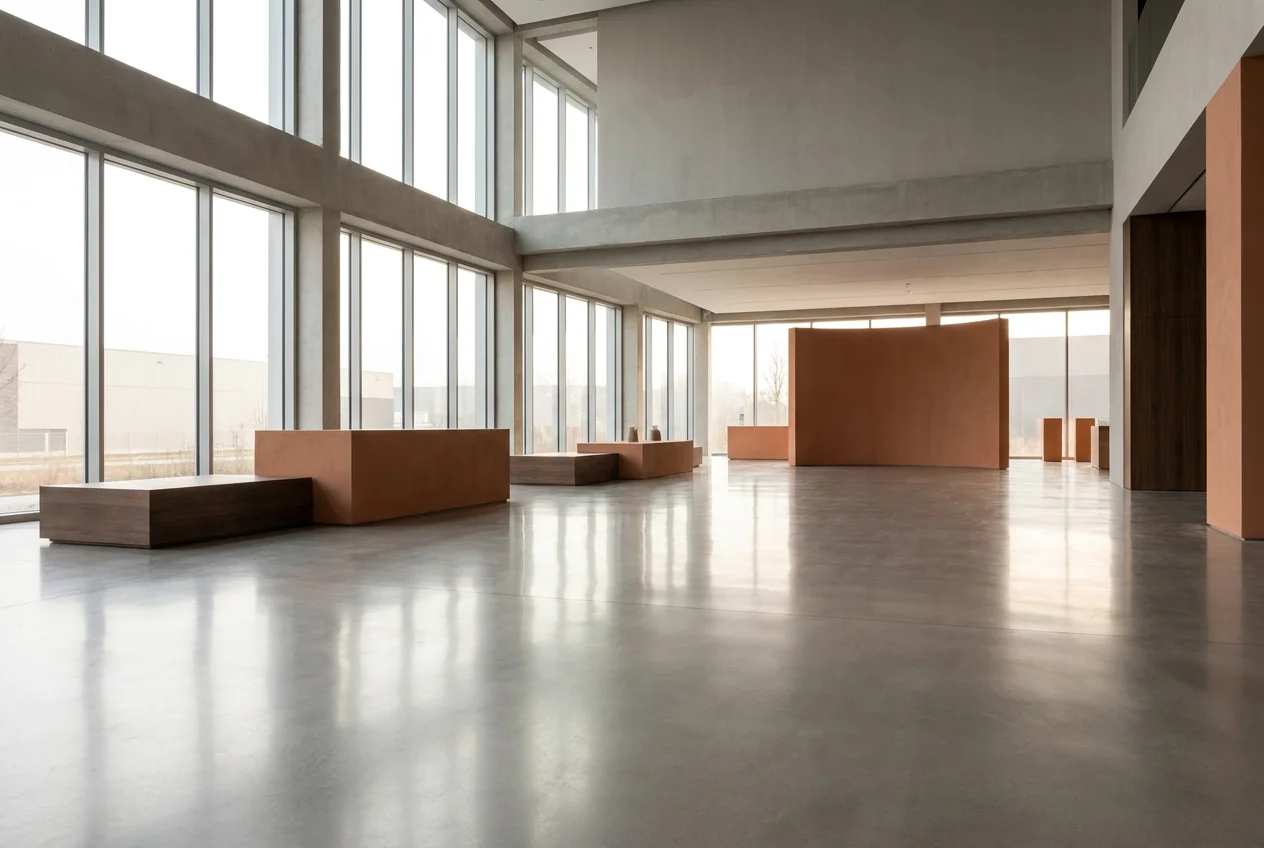
The result is the original slab transformed into a hard, dense, reflective surface that reads as polished stone. There is no coating sitting on top, so there is nothing that can chip, peel or hot-tire fail. The slab is the floor.
Polished concrete estimate in Black Lick, Pennsylvania by phone
Call (844) 623-0663The grinding and polishing process

- Phone quote.Square footage, slab age, target gloss, color. Most quotes firm after one call.
- Grind and expose.Heavy diamond grinders cut at 40 grit. Installers in Black Lick and the surrounding area repair joints and cracks in matching color.
- Densify and stain.Lithium silicate densifier penetrates and hardens. Optional acid stain or water-based dye. Stain guard final treatment.
- Polish.Progressive grit passes 200, 400, 800, 1500, up to 3000. Gloss locked at target meter reading. Photo handover.
Talk to a polished concrete installer in Black Lick, Pennsylvania
One call. A written quote. Licensed pros near you.
Call (844) 623-0663Frequently asked questions

How much does polished concrete cost in Black Lick, Pennsylvania?
Standard cream-polish residential and light-duty runs $4 to $7 per square foot. Showroom mirror-grade with aggregate exposure and dye is $7 to $12 per square foot. Warehouse-scale (10,000+ sq ft) drops to $3 to $5 range. Quoted firm after the call.
How is this different from epoxy?
Epoxy is a coating that sits on top of the slab. Polished concrete is the slab itself, ground and densified. Epoxy can chip, peel, hot-tire pickup. Polished concrete cannot, there is no coating to fail.
Do you serve Black Lick?
Yes, installers are dispatched in Black Lick and the surrounding area. One call confirms availability and a written estimate.
How long does the install take?
Residential rooms run two to three days. larger floors 5,000 to 20,000 sq ft run a week to two weeks. The space is dust-controlled with wet grinding and HEPA vacuum.
Are the installers insured?
Every installer dispatched is licensed and insured for work in Pennsylvania. Certificate of insurance available before work begins.