
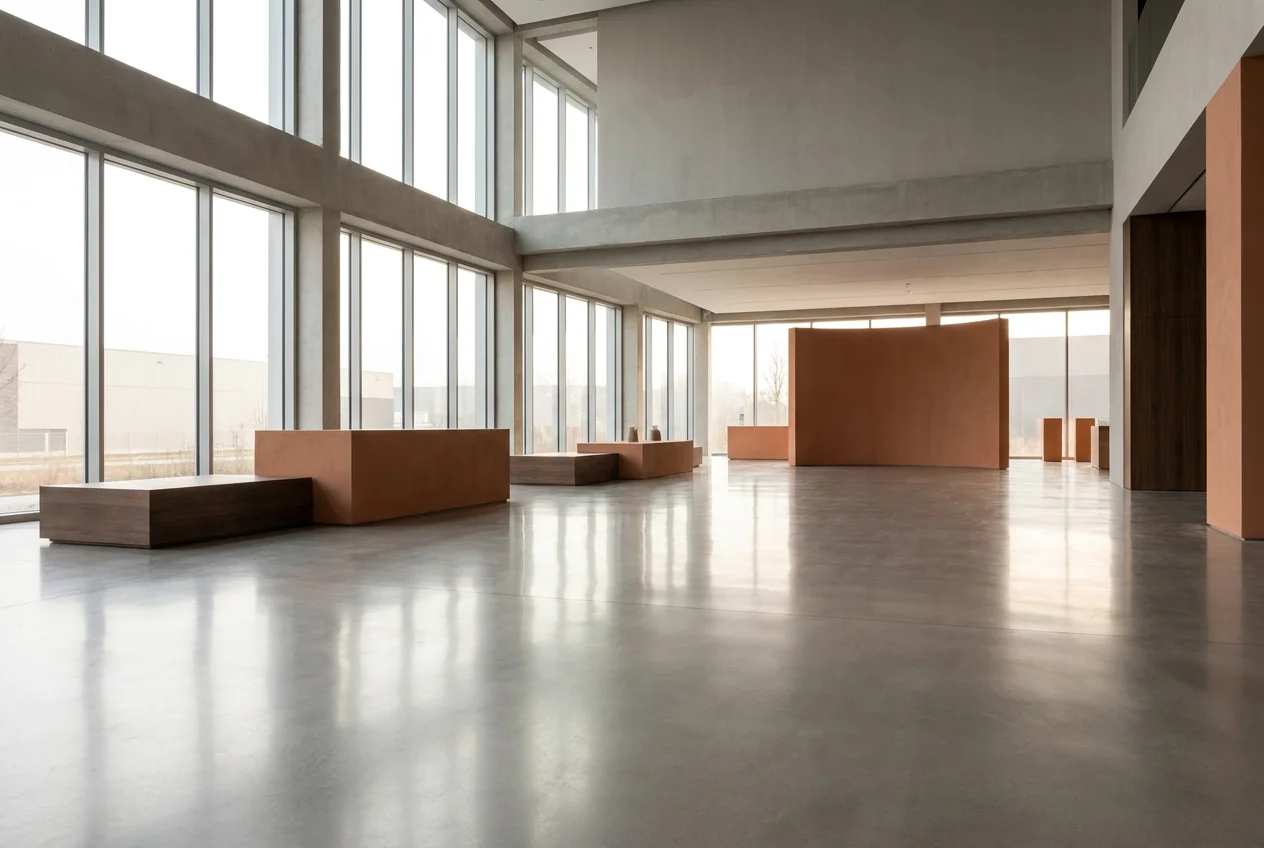
Polished concrete is not a coating applied over a slab. It is the slab itself, refined by progressive mechanical abrasion until the concrete becomes its own finished wear surface. That distinction governs everything downstream: how the floor is priced, how long it lasts, what can go wrong, and why two quotes for the same square footage can differ by a factor of three. A coating sits on top of the substrate and eventually delaminates from it. A polished floor has no interface to fail, because there is no second material involved.
The process is a sequence of diamond abrasive passes, each one removing the scratch pattern left by the pass before it. Coarse work begins with diamonds embedded in a metal matrix, typically in the 30 to 80 grit range, which cuts through the surface cream layer and levels trowel marks, curl, and pour joints. From roughly 100 grit onward the abrasives switch to a resin matrix, and the operation stops being grinding and becomes polishing. A common resin progression runs 100, 200, 400, 800, 1500 and finally 3000 grit. Skipping steps is the single most frequent shortcut in the trade, and it is visible: the floor reaches gloss but keeps a haze of unrefined scratches underneath that no amount of buffing removes.
What the densifier actually does
Somewhere between the 200 and 400 grit passes, a chemical densifier is applied. Lithium silicate is the common choice on modern work, though sodium and potassium silicates remain in use. The chemistry is straightforward: cured concrete contains free calcium hydroxide, a soft and soluble byproduct of hydration. The silicate penetrates the open pore structure and reacts with that calcium hydroxide to form additional calcium silicate hydrate, the same compound that gives concrete its strength in the first place.
The practical effects are threefold. The surface hardens, so the finer resin passes can develop reflectivity instead of simply burnishing soft paste. Dusting stops, because the loose lime that would otherwise migrate to the surface has been consumed. And the pore network tightens, which is what gives a polished floor its resistance to oil and water intrusion. A floor polished without densification can look acceptable on handover day and be visibly worn within eighteen months in a traffic lane.
Reading a specification: gloss level and aggregate exposure
The Concrete Polishing Council classifies finished floors on two independent axes, and confusing them is the source of most disappointment. Gloss is graded 1 through 4, where Level 1 is a ground, flat, matte surface and Level 4 is a highly polished finish that returns a clear reflection when viewed from standing height. Aggregate exposure is graded A through D: A retains the cream paste with no stone showing, B exposes fine sand, C exposes medium aggregate, and D exposes the large stone.
These two axes do not move together. A Level 4 gloss with Class A exposure is a mirror-finish cream floor. A Level 2 gloss with Class D exposure is a matte terrazzo-like surface with full stone showing. Both are legitimate; they are different products. Exposure is decided in the first coarse pass and cannot be revised later, because it is a function of how much material was removed. Gloss can always be raised afterward by continuing the resin sequence. A specification that names only one axis is incomplete.
Aggregate exposure also depends on something the contractor cannot control: how the slab was poured. Concrete placed with a high slump, over-troweled, or finished with a power trowel driving paste to the surface will have a deep cream layer and stone that sits well below cutting depth. Exposing it means removing an eighth of an inch or more of material, which changes the equipment, the number of passes, and the price. This is why an honest estimator asks to see the slab before quoting, and why a phone quote for polished concrete is a guess.
Where polished concrete belongs, and where it does not
The finish earns its reputation in high-traffic interior environments with a sound existing slab: retail floors, warehouse and distribution aisles, showrooms, restaurants, offices, and increasingly residential open-plan interiors. In those settings it outperforms nearly every alternative on lifecycle cost, because maintenance is dust mopping and periodic auto-scrubbing rather than stripping and recoating. There is no wax layer to rebuild and no coating to reapply on a cycle.
It is the wrong choice in several situations, and a contractor who never says so is worth avoiding. Slabs with widespread structural cracking need repair or replacement first, since polishing highlights cracks rather than hiding them. Areas subject to standing acids or aggressive chemicals want a chemically resistant coating instead, because polished concrete remains cementitious and reactive. Freezer and cold-storage floors, exterior slabs exposed to freeze-thaw, and surfaces requiring a slip rating beyond what a polished profile provides all point elsewhere. And a slab with a moisture problem will not be cured by polishing.
Grind and seal is a different product
A substantial share of floors sold as polished concrete are not polished at all. Grind and seal means the slab is ground to open the surface, then a topical sealer, usually a urethane or acrylic, is applied to produce shine. The result can look similar on day one at meaningfully lower cost. The difference emerges over time: the gloss belongs to the sealer, so when the sealer wears through in traffic lanes, the floor needs to be stripped and resealed.
Neither approach is dishonest, but the two should never be quoted against each other as equivalents. If a bid is markedly cheaper than the others, the first question is which of the two it describes. The second is how many resin grit passes are included and where the densifier falls in the sequence. Those two answers separate a floor that will still look right in a decade from one that will need attention in the third year.
What to establish before work starts
Moisture is the first item. Concrete that transmits vapor will not affect a polished floor the way it destroys a coating, but a slab with a persistent moisture drive can push efflorescence to the surface and interfere with densifier performance. Where the slab is on grade without a functioning vapor barrier, that should be understood before the first pass rather than discovered afterward.
Slab flatness is the second. Polishing follows the plane the slab already occupies; it does not level a floor. A slab with significant curl at joints or a wavy pour will polish to a shiny wavy floor. If flatness matters, it is corrected by a self-leveling underlayment or a heavier cut, both of which change the scope.
Joint treatment is the third and the most commonly overlooked. Control joints and construction joints in a polished floor need a semi-rigid filler installed after the floor has done most of its shrinking, so that traffic and hard-wheeled equipment do not spall the joint edges. Filling joints too early guarantees the filler will separate.
Finally, the maintenance regime should be agreed in writing. A polished floor is maintained with clean water, a neutral pH cleaner, and a scrubber with the correct pad. Acidic cleaners attack the calcium silicate hydrate the densifier created. Alkaline degreasers used repeatedly dull the finish. More polished floors are ruined by janitorial chemistry than by traffic.
Costs across the United States vary with slab condition, exposure class, gloss level, square footage, and how much of the work has to happen outside business hours. A large, sound, unobstructed warehouse slab at a modest exposure class sits at the low end. A small residential floor requiring aggregate exposure, joint repair, and furniture handling sits at the high end. Collecting at least three quotes and comparing them on grit sequence and densifier rather than on headline price is the most reliable way to judge them.
States in the Northeast
- Polished Concrete Floors in Connecticut
- Polished Concrete Floors in Maine
- Polished Concrete Floors in Massachusetts
- Polished Concrete Floors in New Hampshire
- Polished Concrete Floors in New Jersey
- Polished Concrete Floors in New York
- Polished Concrete Floors in Pennsylvania
- Polished Concrete Floors in Rhode Island
- Polished Concrete Floors in Vermont
States in the Midwest
- Polished Concrete Floors in Illinois
- Polished Concrete Floors in Indiana
- Polished Concrete Floors in Iowa
- Polished Concrete Floors in Kansas
- Polished Concrete Floors in Michigan
- Polished Concrete Floors in Minnesota
- Polished Concrete Floors in Missouri
- Polished Concrete Floors in Nebraska
- Polished Concrete Floors in North Dakota
- Polished Concrete Floors in Ohio
- Polished Concrete Floors in South Dakota
- Polished Concrete Floors in Wisconsin
States in the South
- Polished Concrete Floors in Alabama
- Polished Concrete Floors in Arkansas
- Polished Concrete Floors in Delaware
- Polished Concrete Floors in Florida
- Polished Concrete Floors in Georgia
- Polished Concrete Floors in Kentucky
- Polished Concrete Floors in Louisiana
- Polished Concrete Floors in Maryland
- Polished Concrete Floors in Mississippi
- Polished Concrete Floors in North Carolina
- Polished Concrete Floors in Oklahoma
- Polished Concrete Floors in South Carolina
- Polished Concrete Floors in Tennessee
- Polished Concrete Floors in Texas
- Polished Concrete Floors in Virginia
- Polished Concrete Floors in Washington, D.C.
- Polished Concrete Floors in West Virginia
States in the West
- Polished Concrete Floors in Alaska
- Polished Concrete Floors in Arizona
- Polished Concrete Floors in California
- Polished Concrete Floors in Colorado
- Polished Concrete Floors in Hawaii
- Polished Concrete Floors in Idaho
- Polished Concrete Floors in Montana
- Polished Concrete Floors in Nevada
- Polished Concrete Floors in New Mexico
- Polished Concrete Floors in Oregon
- Polished Concrete Floors in Utah
- Polished Concrete Floors in Washington
- Polished Concrete Floors in Wyoming
Major cities across the United States
- Polished Concrete Floors in New York City, NY
- Polished Concrete Floors in Long Island, NY
- Polished Concrete Floors in Los Angeles, CA
- Polished Concrete Floors in Chicago, IL
- Polished Concrete Floors in Chicago, WI
- Polished Concrete Floors in Brooklyn, NY
- Polished Concrete Floors in Queens, NY
- Polished Concrete Floors in Houston, TX
- Polished Concrete Floors in Manhattan, NY
- Polished Concrete Floors in Phoenix, AZ
- Polished Concrete Floors in Philadelphia, PA
- Polished Concrete Floors in Eden, CA
- Polished Concrete Floors in San Antonio, TX
- Polished Concrete Floors in The Bronx, NY
- Polished Concrete Floors in Deer Valley, AZ
- Polished Concrete Floors in San Diego, CA
- Polished Concrete Floors in Dallas, TX
- Polished Concrete Floors in Garfield, UT
- Polished Concrete Floors in San Jose, CA
- Polished Concrete Floors in O‘ahu, HI
- Polished Concrete Floors in Austin, TX
- Polished Concrete Floors in Jacksonville, FL
- Polished Concrete Floors in San Francisco, CA
- Polished Concrete Floors in Columbus, OH
- Polished Concrete Floors in Indianapolis, IN
- Polished Concrete Floors in Fort Worth, TX
- Polished Concrete Floors in Charlotte, NC
- Polished Concrete Floors in North Charlotte, NC
- Polished Concrete Floors in Louisville, KY
- Polished Concrete Floors in Lakeside, GA
- Polished Concrete Floors in Seattle, WA
- Polished Concrete Floors in Denver, CO
- Polished Concrete Floors in Washington City, DC
- Polished Concrete Floors in El Paso, TX
- Polished Concrete Floors in Boston, MA
- Polished Concrete Floors in Nashville, TN
- Polished Concrete Floors in Detroit, MI
- Polished Concrete Floors in Una, TN
- Polished Concrete Floors in Memphis, TN
- Polished Concrete Floors in New South Memphis, TN
- Polished Concrete Floors in Portland, OR
- Polished Concrete Floors in Oklahoma City, OK
- Polished Concrete Floors in Las Vegas, NV
- Polished Concrete Floors in Baltimore, MD
- Polished Concrete Floors in Washington, D.C., DC
- Polished Concrete Floors in Milwaukee, WI
- Polished Concrete Floors in South Boston, MA
- Polished Concrete Floors in Fernwood, PA
- Polished Concrete Floors in Albuquerque, NM
- Polished Concrete Floors in Williamson, TX
Polished concrete floors in the United States, USA
usually call after looking at a tired concrete slab in a warehouse, showroom or modern residential space. Polished concrete is the existing slab itself, mechanically refined through a series of diamond-grinding passes from coarse (40 grit) to fine (3000 grit), with a densifier and stain guard applied at the right stage.

The result is the original slab transformed into a hard, dense, reflective surface that reads as polished stone. There is no coating sitting on top, so there is nothing that can chip, peel or hot-tire fail. The slab is the floor.
Polished concrete estimate in the United States, USA by phone
Call (844) 623-0663The grinding and polishing process

- Phone quote.Square footage, slab age, target gloss, color. Most quotes firm after one call.
- Grind and expose.Heavy diamond grinders cut at 40 grit. Installers repair joints and cracks in matching color.
- Densify and stain.Lithium silicate densifier penetrates and hardens. Optional acid stain or water-based dye. Stain guard final treatment.
- Polish.Progressive grit passes 200, 400, 800, 1500, up to 3000. Gloss locked at target meter reading. Photo handover.
Talk to a polished concrete installer in the United States, USA
One call. A written quote. Licensed pros near you.
Call (844) 623-0663Frequently asked questions

How much does polished concrete cost in the United States, USA?
Standard cream-polish residential and light-duty runs $4 to $7 per square foot. Showroom mirror-grade with aggregate exposure and dye is $7 to $12 per square foot. Warehouse-scale (10,000+ sq ft) drops to $3 to $5 range. Quoted firm after the call.
How is this different from epoxy?
Epoxy is a coating that sits on top of the slab. Polished concrete is the slab itself, ground and densified. Epoxy can chip, peel, hot-tire pickup. Polished concrete cannot, there is no coating to fail.
Do you serve United States?
Yes, installers are dispatched . One call confirms availability and a written estimate.
How long does the install take?
Residential rooms run two to three days. larger floors 5,000 to 20,000 sq ft run a week to two weeks. The space is dust-controlled with wet grinding and HEPA vacuum.
Are the installers insured?
Every installer dispatched is . Certificate of insurance available before work begins.